# Residual Networks
Welcome to the second assignment of this week! You will learn how to build very deep convolutional networks, using Residual Networks (ResNets). In theory, very deep networks can represent very complex functions; but in practice, they are hard to train. Residual Networks, introduced by [He et al.](https://arxiv.org/pdf/1512.03385.pdf), allow you to train much deeper networks than were previously practically feasible.
**In this assignment, you will:**
- Implement the basic building blocks of ResNets. 
- Put together these building blocks to implement and train a state-of-the-art neural network for image classification. 
This assignment will be done in Keras. 
Before jumping into the problem, let's run the cell below to load the required packages.

Residual Networks

Welcome to the second assignment of this week! You will learn how to build very deep convolutional networks, using Residual Networks (ResNets). In theory, very deep networks can represent very complex functions; but in practice, they are hard to train. Residual Networks, introduced by He et al., allow you to train much deeper networks than were previously practically feasible.

In this assignment, you will:

  • Implement the basic building blocks of ResNets.
  • Put together these building blocks to implement and train a state-of-the-art neural network for image classification.

This assignment will be done in Keras.

Before jumping into the problem, let's run the cell below to load the required packages.

In [47]:
 
import numpy as np
from keras import layers
from keras.layers import Input, Add, Dense, Activation, ZeroPadding2D, BatchNormalization, Flatten, Conv2D, AveragePooling2D, MaxPooling2D, GlobalMaxPooling2D
from keras.models import Model, load_model
from keras.preprocessing import image
from keras.utils import layer_utils
from keras.utils.data_utils import get_file
from keras.applications.imagenet_utils import preprocess_input
import pydot
from IPython.display import SVG
from keras.utils.vis_utils import model_to_dot
from keras.utils import plot_model
from resnets_utils import *
from keras.initializers import glorot_uniform
import scipy.misc
from matplotlib.pyplot import imshow
%matplotlib inline
import keras.backend as K
K.set_image_data_format('channels_last')
K.set_learning_phase(1)
 
## 1 - The problem of very deep neural networks
Last week, you built your first convolutional neural network. In recent years, neural networks have become deeper, with state-of-the-art networks going from just a few layers (e.g., AlexNet) to over a hundred layers.
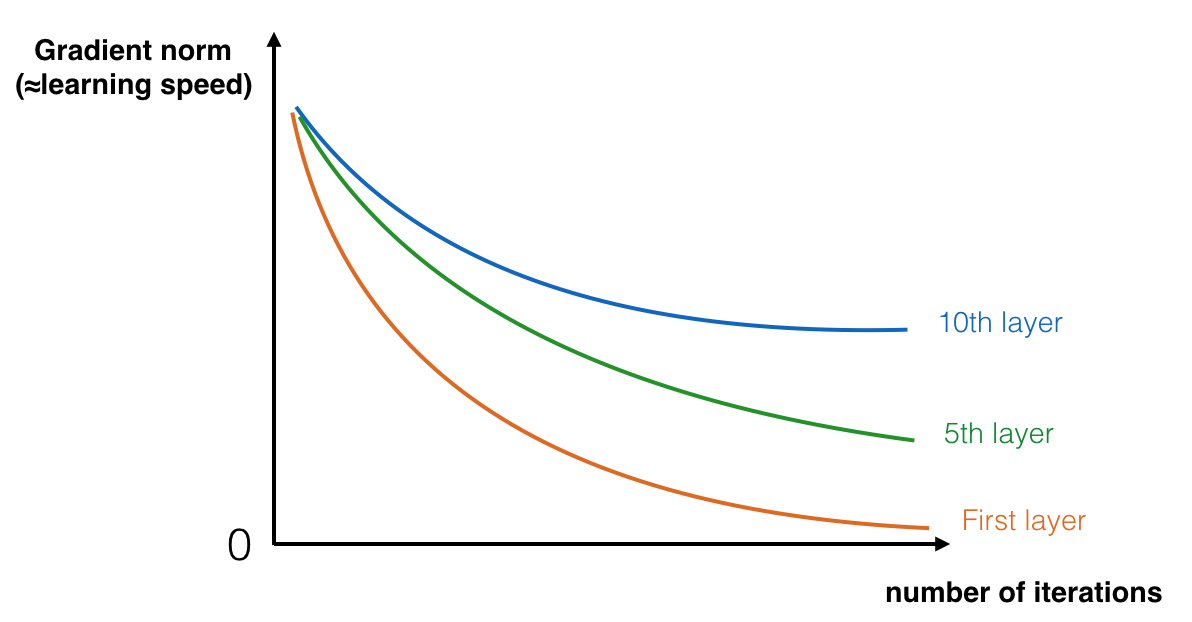
The main benefit of a very deep network is that it can represent very complex functions. It can also learn features at many different levels of abstraction, from edges (at the lower layers) to very complex features (at the deeper layers). However, using a deeper network doesn't always help. A huge barrier to training them is vanishing gradients: very deep networks often have a gradient signal that goes to zero quickly, thus making gradient descent unbearably slow. More specifically, during gradient descent, as you backprop from the final layer back to the first layer, you are multiplying by the weight matrix on each step, and thus the gradient can decrease exponentially quickly to zero (or, in rare cases, grow exponentially quickly and "explode" to take very large values). 
During training, you might therefore see the magnitude (or norm) of the gradient for the earlier layers descrease to zero very rapidly as training proceeds: 

1 - The problem of very deep neural networks

Last week, you built your first convolutional neural network. In recent years, neural networks have become deeper, with state-of-the-art networks going from just a few layers (e.g., AlexNet) to over a hundred layers.

The main benefit of a very deep network is that it can represent very complex functions. It can also learn features at many different levels of abstraction, from edges (at the lower layers) to very complex features (at the deeper layers). However, using a deeper network doesn't always help. A huge barrier to training them is vanishing gradients: very deep networks often have a gradient signal that goes to zero quickly, thus making gradient descent unbearably slow. More specifically, during gradient descent, as you backprop from the final layer back to the first layer, you are multiplying by the weight matrix on each step, and thus the gradient can decrease exponentially quickly to zero (or, in rare cases, grow exponentially quickly and "explode" to take very large values).

During training, you might therefore see the magnitude (or norm) of the gradient for the earlier layers descrease to zero very rapidly as training proceeds:

 
<img src="images/vanishing_grad_kiank.png" style="width:450px;height:220px;">
<caption><center> <u> <font color='purple'> **Figure 1** </u><font color='purple'>  : **Vanishing gradient** <br> The speed of learning decreases very rapidly for the early layers as the network trains </center></caption>
You are now going to solve this problem by building a Residual Network!

Figure 1 : Vanishing gradient
The speed of learning decreases very rapidly for the early layers as the network trains

You are now going to solve this problem by building a Residual Network!

 
## 2 - Building a Residual Network
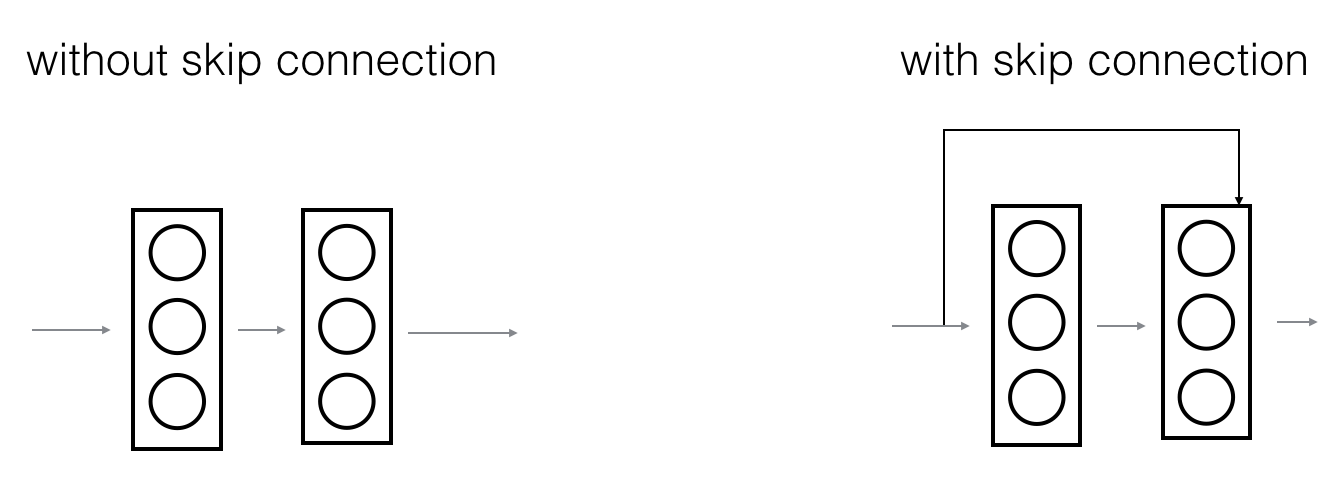
In ResNets, a "shortcut" or a "skip connection" allows the gradient to be directly backpropagated to earlier layers:  
<img src="images/skip_connection_kiank.png" style="width:650px;height:200px;">
<caption><center> <u> <font color='purple'> **Figure 2** </u><font color='purple'>  : A ResNet block showing a **skip-connection** <br> </center></caption>
The image on the left shows the "main path" through the network. The image on the right adds a shortcut to the main path. By stacking these ResNet blocks on top of each other, you can form a very deep network. 
We also saw in lecture that having ResNet blocks with the shortcut also makes it very easy for one of the blocks to learn an identity function. This means that you can stack on additional ResNet blocks with little risk of harming training set performance. (There is also some evidence that the ease of learning an identity function--even more than skip connections helping with vanishing gradients--accounts for ResNets' remarkable performance.)
Two main types of blocks are used in a ResNet, depending mainly on whether the input/output dimensions are same or different. You are going to implement both of them. 

2 - Building a Residual Network

In ResNets, a "shortcut" or a "skip connection" allows the gradient to be directly backpropagated to earlier layers:

Figure 2 : A ResNet block showing a skip-connection

The image on the left shows the "main path" through the network. The image on the right adds a shortcut to the main path. By stacking these ResNet blocks on top of each other, you can form a very deep network.

We also saw in lecture that having ResNet blocks with the shortcut also makes it very easy for one of the blocks to learn an identity function. This means that you can stack on additional ResNet blocks with little risk of harming training set performance. (There is also some evidence that the ease of learning an identity function--even more than skip connections helping with vanishing gradients--accounts for ResNets' remarkable performance.)

Two main types of blocks are used in a ResNet, depending mainly on whether the input/output dimensions are same or different. You are going to implement both of them.

xxxxxxxxxx
 
### 2.1 - The identity block
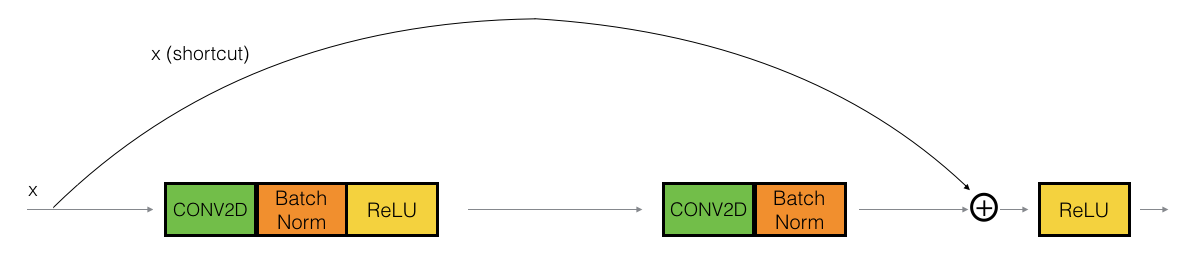
The identity block is the standard block used in ResNets, and corresponds to the case where the input activation (say $a^{[l]}$) has the same dimension as the output activation (say $a^{[l+2]}$). To flesh out the different steps of what happens in a ResNet's identity block, here is an alternative diagram showing the individual steps:
<img src="images/idblock2_kiank.png" style="width:650px;height:150px;">
<caption><center> <u> <font color='purple'> **Figure 3** </u><font color='purple'>  : **Identity block.** Skip connection "skips over" 2 layers. </center></caption>
The upper path is the "shortcut path." The lower path is the "main path." In this diagram, we have also made explicit the CONV2D and ReLU steps in each layer. To speed up training we have also added a BatchNorm step. Don't worry about this being complicated to implement--you'll see that BatchNorm is just one line of code in Keras! 
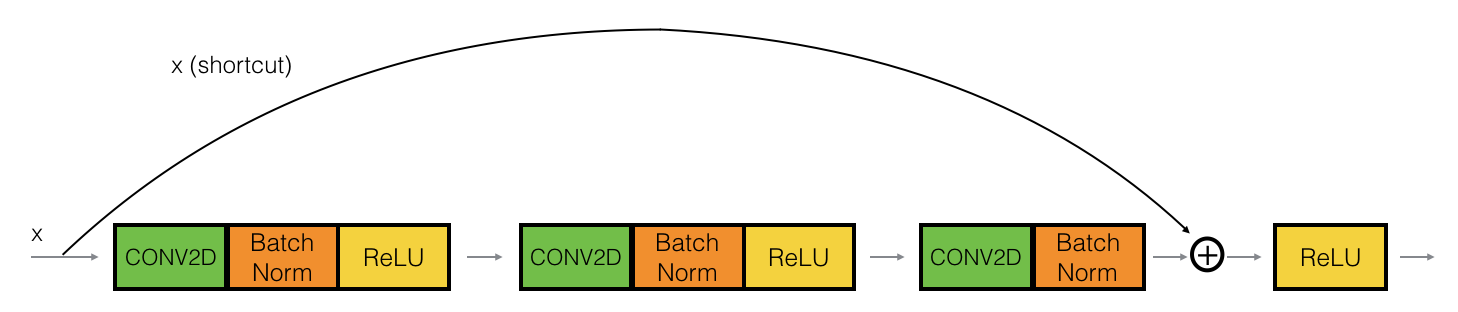
In this exercise, you'll actually implement a slightly more powerful version of this identity block, in which the skip connection "skips over" 3 hidden layers rather than 2 layers. It looks like this: 
<img src="images/idblock3_kiank.png" style="width:650px;height:150px;">
<caption><center> <u> <font color='purple'> **Figure 4** </u><font color='purple'>  : **Identity block.** Skip connection "skips over" 3 layers.</center></caption>
Here're the individual steps.
First component of main path: 
- The first CONV2D has $F_1$ filters of shape (1,1) and a stride of (1,1). Its padding is "valid" and its name should be `conv_name_base + '2a'`. Use 0 as the seed for the random initialization. 
- The first BatchNorm is normalizing the channels axis.  Its name should be `bn_name_base + '2a'`.
- Then apply the ReLU activation function. This has no name and no hyperparameters. 
Second component of main path:
- The second CONV2D has $F_2$ filters of shape $(f,f)$ and a stride of (1,1). Its padding is "same" and its name should be `conv_name_base + '2b'`. Use 0 as the seed for the random initialization. 
- The second BatchNorm is normalizing the channels axis.  Its name should be `bn_name_base + '2b'`.
- Then apply the ReLU activation function. This has no name and no hyperparameters. 
Third component of main path:
- The third CONV2D has $F_3$ filters of shape (1,1) and a stride of (1,1). Its padding is "valid" and its name should be `conv_name_base + '2c'`. Use 0 as the seed for the random initialization. 
- The third BatchNorm is normalizing the channels axis.  Its name should be `bn_name_base + '2c'`. Note that there is no ReLU activation function in this component. 
Final step: 
- The shortcut and the input are added together.
- Then apply the ReLU activation function. This has no name and no hyperparameters. 
**Exercise**: Implement the ResNet identity block. We have implemented the first component of the main path. Please read over this carefully to make sure you understand what it is doing. You should implement the rest. 
- To implement the Conv2D step: [See reference](https://keras.io/layers/convolutional/#conv2d)
- To implement BatchNorm: [See reference](https://faroit.github.io/keras-docs/1.2.2/layers/normalization/) (axis: Integer, the axis that should be normalized (typically the channels axis))
- For the activation, use:  `Activation('relu')(X)`
- To add the value passed forward by the shortcut: [See reference](https://keras.io/layers/merge/#add)

2.1 - The identity block

The identity block is the standard block used in ResNets, and corresponds to the case where the input activation (say a[l]) has the same dimension as the output activation (say a[l+2]). To flesh out the different steps of what happens in a ResNet's identity block, here is an alternative diagram showing the individual steps:

Figure 3 : Identity block. Skip connection "skips over" 2 layers.

The upper path is the "shortcut path." The lower path is the "main path." In this diagram, we have also made explicit the CONV2D and ReLU steps in each layer. To speed up training we have also added a BatchNorm step. Don't worry about this being complicated to implement--you'll see that BatchNorm is just one line of code in Keras!

In this exercise, you'll actually implement a slightly more powerful version of this identity block, in which the skip connection "skips over" 3 hidden layers rather than 2 layers. It looks like this:

Figure 4 : Identity block. Skip connection "skips over" 3 layers.

Here're the individual steps.

First component of main path:

  • The first CONV2D has F1 filters of shape (1,1) and a stride of (1,1). Its padding is "valid" and its name should be conv_name_base + '2a'. Use 0 as the seed for the random initialization.
  • The first BatchNorm is normalizing the channels axis. Its name should be bn_name_base + '2a'.
  • Then apply the ReLU activation function. This has no name and no hyperparameters.

Second component of main path:

  • The second CONV2D has F2 filters of shape (f,f) and a stride of (1,1). Its padding is "same" and its name should be conv_name_base + '2b'. Use 0 as the seed for the random initialization.
  • The second BatchNorm is normalizing the channels axis. Its name should be bn_name_base + '2b'.
  • Then apply the ReLU activation function. This has no name and no hyperparameters.

Third component of main path:

  • The third CONV2D has F3 filters of shape (1,1) and a stride of (1,1). Its padding is "valid" and its name should be conv_name_base + '2c'. Use 0 as the seed for the random initialization.
  • The third BatchNorm is normalizing the channels axis. Its name should be bn_name_base + '2c'. Note that there is no ReLU activation function in this component.

Final step:

  • The shortcut and the input are added together.
  • Then apply the ReLU activation function. This has no name and no hyperparameters.

Exercise: Implement the ResNet identity block. We have implemented the first component of the main path. Please read over this carefully to make sure you understand what it is doing. You should implement the rest.

  • To implement the Conv2D step: See reference
  • To implement BatchNorm: See reference (axis: Integer, the axis that should be normalized (typically the channels axis))
  • For the activation, use: Activation('relu')(X)
  • To add the value passed forward by the shortcut: See reference
In [54]:
x
# GRADED FUNCTION: identity_block
def identity_block(X, f, filters, stage, block):
    """
    Implementation of the identity block as defined in Figure 3
    
    Arguments:
    X -- input tensor of shape (m, n_H_prev, n_W_prev, n_C_prev)
    f -- integer, specifying the shape of the middle CONV's window for the main path
    filters -- python list of integers, defining the number of filters in the CONV layers of the main path
    stage -- integer, used to name the layers, depending on their position in the network
    block -- string/character, used to name the layers, depending on their position in the network
    
    Returns:
    X -- output of the identity block, tensor of shape (n_H, n_W, n_C)
    """
    
    # defining name basis
    conv_name_base = 'res' + str(stage) + block + '_branch'
    bn_name_base = 'bn' + str(stage) + block + '_branch'
    
    # Retrieve Filters
    F1, F2, F3 = filters
    
    # Save the input value. You'll need this later to add back to the main path. 
    X_shortcut = X
    
    # First component of main path
    X = Conv2D(filters = F1, kernel_size = (1, 1), strides = (1,1), padding = 'valid', name = conv_name_base + '2a', kernel_initializer = glorot_uniform(seed=0))(X)
    X = BatchNormalization(axis = 3, name = bn_name_base + '2a')(X)
    X = Activation('relu')(X)
    
    ### START CODE HERE ###
    
    # Second component of main path (≈3 lines)
    X = Conv2D(filters = F2, kernel_size = (f, f), strides = (1,1), padding = 'same', name = conv_name_base + '2b', kernel_initializer = glorot_uniform(seed=0))(X)
    X = BatchNormalization(axis = 3, name = bn_name_base + '2b')(X)
    X = Activation('relu')(X)
    # Third component of main path (≈2 lines)
    X = Conv2D(filters = F3, kernel_size = (1, 1), strides = (1,1), padding = 'valid', name = conv_name_base + '2c', kernel_initializer = glorot_uniform(seed=0))(X)
    X = BatchNormalization(axis = 3, name = bn_name_base + '2c')(X)
    # Final step: Add shortcut value to main path, and pass it through a RELU activation (≈2 lines)
    #  keras.layers.Add()([x1, x2]) 
    X = Add()([X, X_shortcut]) 
    X = Activation('relu')(X)
    
    ### END CODE HERE ###
    
    return X
In [55]:
 
tf.reset_default_graph()
with tf.Session() as test:
    np.random.seed(1)
    A_prev = tf.placeholder("float", [3, 4, 4, 6])
    X = np.random.randn(3, 4, 4, 6)
    A = identity_block(A_prev, f = 2, filters = [2, 4, 6], stage = 1, block = 'a')
    test.run(tf.global_variables_initializer())
    out = test.run([A], feed_dict={A_prev: X, K.learning_phase(): 0})
    print("out = " + str(out[0][1][1][0]))
out = [ 0.94822985  0.          1.16101444  2.747859    0.          1.36677003]
 
**Expected Output**:
<table>
    <tr>
        <td>
            **out**
        </td>
        <td>
           [ 0.94822985  0.          1.16101444  2.747859    0.          1.36677003]
        </td>
    </tr>
</table>

Expected Output:

out [ 0.94822985 0. 1.16101444 2.747859 0. 1.36677003]
 
## 2.2 - The convolutional block
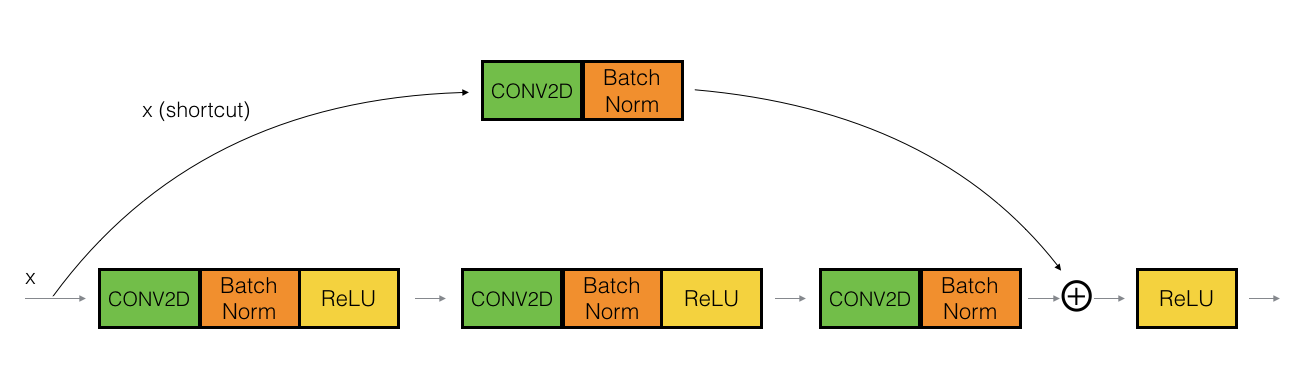
You've implemented the ResNet identity block. Next, the ResNet "convolutional block" is the other type of block. You can use this type of block when the input and output dimensions don't match up. The difference with the identity block is that there is a CONV2D layer in the shortcut path: 
<img src="images/convblock_kiank.png" style="width:650px;height:150px;">
<caption><center> <u> <font color='purple'> **Figure 4** </u><font color='purple'>  : **Convolutional block** </center></caption>
The CONV2D layer in the shortcut path is used to resize the input $x$ to a different dimension, so that the dimensions match up in the final addition needed to add the shortcut value back to the main path. (This plays a similar role as the matrix $W_s$ discussed in lecture.) For example, to reduce the activation dimensions's height and width by a factor of 2, you can use a 1x1 convolution with a stride of 2. The CONV2D layer on the shortcut path does not use any non-linear activation function. Its main role is to just apply a (learned) linear function that reduces the dimension of the input, so that the dimensions match up for the later addition step. 
The details of the convolutional block are as follows. 
First component of main path:
- The first CONV2D has $F_1$ filters of shape (1,1) and a stride of (s,s). Its padding is "valid" and its name should be `conv_name_base + '2a'`. 
- The first BatchNorm is normalizing the channels axis.  Its name should be `bn_name_base + '2a'`.
- Then apply the ReLU activation function. This has no name and no hyperparameters. 
Second component of main path:
- The second CONV2D has $F_2$ filters of (f,f) and a stride of (1,1). Its padding is "same" and it's name should be `conv_name_base + '2b'`.
- The second BatchNorm is normalizing the channels axis.  Its name should be `bn_name_base + '2b'`.
- Then apply the ReLU activation function. This has no name and no hyperparameters. 
Third component of main path:
- The third CONV2D has $F_3$ filters of (1,1) and a stride of (1,1). Its padding is "valid" and it's name should be `conv_name_base + '2c'`.
- The third BatchNorm is normalizing the channels axis.  Its name should be `bn_name_base + '2c'`. Note that there is no ReLU activation function in this component. 
Shortcut path:
- The CONV2D has $F_3$ filters of shape (1,1) and a stride of (s,s). Its padding is "valid" and its name should be `conv_name_base + '1'`.
- The BatchNorm is normalizing the channels axis.  Its name should be `bn_name_base + '1'`. 
Final step: 
- The shortcut and the main path values are added together.
- Then apply the ReLU activation function. This has no name and no hyperparameters. 
    
**Exercise**: Implement the convolutional block. We have implemented the first component of the main path; you should implement the rest. As before, always use 0 as the seed for the random initialization, to ensure consistency with our grader.
- [Conv Hint](https://keras.io/layers/convolutional/#conv2d)
- [BatchNorm Hint](https://keras.io/layers/normalization/#batchnormalization) (axis: Integer, the axis that should be normalized (typically the features axis))
- For the activation, use:  `Activation('relu')(X)`
- [Addition Hint](https://keras.io/layers/merge/#add)

2.2 - The convolutional block

You've implemented the ResNet identity block. Next, the ResNet "convolutional block" is the other type of block. You can use this type of block when the input and output dimensions don't match up. The difference with the identity block is that there is a CONV2D layer in the shortcut path:

Figure 4 : Convolutional block

The CONV2D layer in the shortcut path is used to resize the input x to a different dimension, so that the dimensions match up in the final addition needed to add the shortcut value back to the main path. (This plays a similar role as the matrix Ws discussed in lecture.) For example, to reduce the activation dimensions's height and width by a factor of 2, you can use a 1x1 convolution with a stride of 2. The CONV2D layer on the shortcut path does not use any non-linear activation function. Its main role is to just apply a (learned) linear function that reduces the dimension of the input, so that the dimensions match up for the later addition step.

The details of the convolutional block are as follows.

First component of main path:

  • The first CONV2D has F1 filters of shape (1,1) and a stride of (s,s). Its padding is "valid" and its name should be conv_name_base + '2a'.
  • The first BatchNorm is normalizing the channels axis. Its name should be bn_name_base + '2a'.
  • Then apply the ReLU activation function. This has no name and no hyperparameters.

Second component of main path:

  • The second CONV2D has F2 filters of (f,f) and a stride of (1,1). Its padding is "same" and it's name should be conv_name_base + '2b'.
  • The second BatchNorm is normalizing the channels axis. Its name should be bn_name_base + '2b'.
  • Then apply the ReLU activation function. This has no name and no hyperparameters.

Third component of main path:

  • The third CONV2D has F3 filters of (1,1) and a stride of (1,1). Its padding is "valid" and it's name should be conv_name_base + '2c'.
  • The third BatchNorm is normalizing the channels axis. Its name should be bn_name_base + '2c'. Note that there is no ReLU activation function in this component.

Shortcut path:

  • The CONV2D has F3 filters of shape (1,1) and a stride of (s,s). Its padding is "valid" and its name should be conv_name_base + '1'.
  • The BatchNorm is normalizing the channels axis. Its name should be bn_name_base + '1'.

Final step:

  • The shortcut and the main path values are added together.
  • Then apply the ReLU activation function. This has no name and no hyperparameters.

Exercise: Implement the convolutional block. We have implemented the first component of the main path; you should implement the rest. As before, always use 0 as the seed for the random initialization, to ensure consistency with our grader.

In [56]:
x
 
# GRADED FUNCTION: convolutional_block
def convolutional_block(X, f, filters, stage, block, s = 2):
    """
    Implementation of the convolutional block as defined in Figure 4
    
    Arguments:
    X -- input tensor of shape (m, n_H_prev, n_W_prev, n_C_prev)
    f -- integer, specifying the shape of the middle CONV's window for the main path
    filters -- python list of integers, defining the number of filters in the CONV layers of the main path
    stage -- integer, used to name the layers, depending on their position in the network
    block -- string/character, used to name the layers, depending on their position in the network
    s -- Integer, specifying the stride to be used
    
    Returns:
    X -- output of the convolutional block, tensor of shape (n_H, n_W, n_C)
    """
    
    # defining name basis
    conv_name_base = 'res' + str(stage) + block + '_branch'
    bn_name_base = 'bn' + str(stage) + block + '_branch'
    
    # Retrieve Filters
    F1, F2, F3 = filters
    
    # Save the input value
    X_shortcut = X
    ##### MAIN PATH #####
    # First component of main path 
    X = Conv2D(F1, (1, 1), strides = (s,s), name = conv_name_base + '2a', kernel_initializer = glorot_uniform(seed=0))(X)
    X = BatchNormalization(axis = 3, name = bn_name_base + '2a')(X)
    X = Activation('relu')(X)
    # print("after Conv2D-1",X)
    
    ### START CODE HERE ###
    # Second component of main path (≈3 lines)
    X = Conv2D(F2, (f, f), strides = (1,1), name = conv_name_base + '2b', padding='same',kernel_initializer = glorot_uniform(seed=0))(X)
    X = BatchNormalization(axis = 3, name = bn_name_base + '2b')(X)
    X = Activation('relu')(X)
    # print("after Conv2D-2",X)
    # Third component of main path (≈2 lines)
    X = Conv2D(F3, (1, 1), strides = (1,1), name = conv_name_base + '2c', kernel_initializer = glorot_uniform(seed=0))(X)
    X = BatchNormalization(axis = 3, name = bn_name_base + '2c')(X)
    # print("after Conv2D-3",X)
    ##### SHORTCUT PATH #### (≈2 lines)
    X_shortcut = Conv2D(F3, (1, 1), strides = (s,s), name = conv_name_base + '1', kernel_initializer = glorot_uniform(seed=0))(X_shortcut)
    X_shortcut = BatchNormalization(axis = 3, name = bn_name_base + '1')(X_shortcut)
    # print("X_shortcut Conv2D-1",X)
    # Final step: Add shortcut value to main path, and pass it through a RELU activation (≈2 lines)
    # X = X+X_shortcut
    X =Add()([X, X_shortcut]) 
    X = Activation('relu')(X)
    
    ### END CODE HERE ###
    
    return X
In [57]:
 
tf.reset_default_graph()
with tf.Session() as test:
    np.random.seed(1)
    A_prev = tf.placeholder("float", [3, 4, 4, 6])
    X = np.random.randn(3, 4, 4, 6)
    A = convolutional_block(A_prev, f = 2, filters = [2, 4, 6], stage = 1, block = 'a')
    test.run(tf.global_variables_initializer())
    out = test.run([A], feed_dict={A_prev: X, K.learning_phase(): 0})
    print("out = " + str(out[0][1][1][0]))
out = [ 0.09018463  1.23489773  0.46822017  0.0367176   0.          0.65516603]
 
**Expected Output**:
<table>
    <tr>
        <td>
            **out**
        </td>
        <td>
           [ 0.09018463  1.23489773  0.46822017  0.0367176   0.          0.65516603]
        </td>
    </tr>
</table>

Expected Output:

out [ 0.09018463 1.23489773 0.46822017 0.0367176 0. 0.65516603]
 
## 3 - Building your first ResNet model (50 layers)
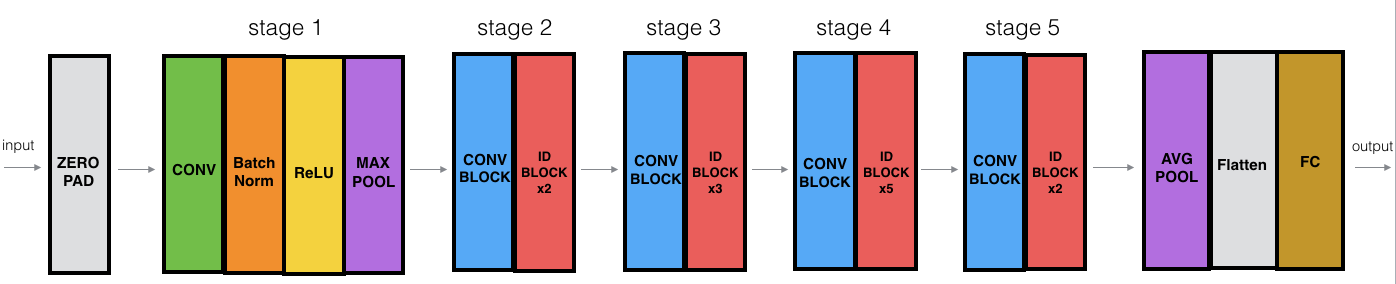
You now have the necessary blocks to build a very deep ResNet. The following figure describes in detail the architecture of this neural network. "ID BLOCK" in the diagram stands for "Identity block," and "ID BLOCK x3" means you should stack 3 identity blocks together.
<img src="images/resnet_kiank.png" style="width:850px;height:150px;">
<caption><center> <u> <font color='purple'> **Figure 5** </u><font color='purple'>  : **ResNet-50 model** </center></caption>
The details of this ResNet-50 model are:
- Zero-padding pads the input with a pad of (3,3)
- Stage 1:
    - The 2D Convolution has 64 filters of shape (7,7) and uses a stride of (2,2). Its name is "conv1".
    - BatchNorm is applied to the channels axis of the input.
    - MaxPooling uses a (3,3) window and a (2,2) stride.
- Stage 2:
    - The convolutional block uses three set of filters of size [64,64,256], "f" is 3, "s" is 1 and the block is "a".
    - The 2 identity blocks use three set of filters of size [64,64,256], "f" is 3 and the blocks are "b" and "c".
- Stage 3:
    - The convolutional block uses three set of filters of size [128,128,512], "f" is 3, "s" is 2 and the block is "a".
    - The 3 identity blocks use three set of filters of size [128,128,512], "f" is 3 and the blocks are "b", "c" and "d".
- Stage 4:
    - The convolutional block uses three set of filters of size [256, 256, 1024], "f" is 3, "s" is 2 and the block is "a".
    - The 5 identity blocks use three set of filters of size [256, 256, 1024], "f" is 3 and the blocks are "b", "c", "d", "e" and "f".
- Stage 5:
    - The convolutional block uses three set of filters of size [512, 512, 2048], "f" is 3, "s" is 2 and the block is "a".
    - The 2 identity blocks use three set of filters of size [512, 512, 2048], "f" is 3 and the blocks are "b" and "c".
- The 2D Average Pooling uses a window of shape (2,2) and its name is "avg_pool".
- The flatten doesn't have any hyperparameters or name.
- The Fully Connected (Dense) layer reduces its input to the number of classes using a softmax activation. Its name should be `'fc' + str(classes)`.
**Exercise**: Implement the ResNet with 50 layers described in the figure above. We have implemented Stages 1 and 2. Please implement the rest. (The syntax for implementing Stages 3-5 should be quite similar to that of Stage 2.) Make sure you follow the naming convention in the text above. 
You'll need to use this function: 
- Average pooling [see reference](https://keras.io/layers/pooling/#averagepooling2d)
Here're some other functions we used in the code below:
- Conv2D: [See reference](https://keras.io/layers/convolutional/#conv2d)
- BatchNorm: [See reference](https://keras.io/layers/normalization/#batchnormalization) (axis: Integer, the axis that should be normalized (typically the features axis))
- Zero padding: [See reference](https://keras.io/layers/convolutional/#zeropadding2d)
- Max pooling: [See reference](https://keras.io/layers/pooling/#maxpooling2d)
- Fully conected layer: [See reference](https://keras.io/layers/core/#dense)
- Addition: [See reference](https://keras.io/layers/merge/#add)

3 - Building your first ResNet model (50 layers)

You now have the necessary blocks to build a very deep ResNet. The following figure describes in detail the architecture of this neural network. "ID BLOCK" in the diagram stands for "Identity block," and "ID BLOCK x3" means you should stack 3 identity blocks together.

Figure 5 : ResNet-50 model

The details of this ResNet-50 model are:

  • Zero-padding pads the input with a pad of (3,3)
  • Stage 1:
    • The 2D Convolution has 64 filters of shape (7,7) and uses a stride of (2,2). Its name is "conv1".
    • BatchNorm is applied to the channels axis of the input.
    • MaxPooling uses a (3,3) window and a (2,2) stride.
  • Stage 2:
    • The convolutional block uses three set of filters of size [64,64,256], "f" is 3, "s" is 1 and the block is "a".
    • The 2 identity blocks use three set of filters of size [64,64,256], "f" is 3 and the blocks are "b" and "c".
  • Stage 3:
    • The convolutional block uses three set of filters of size [128,128,512], "f" is 3, "s" is 2 and the block is "a".
    • The 3 identity blocks use three set of filters of size [128,128,512], "f" is 3 and the blocks are "b", "c" and "d".
  • Stage 4:
    • The convolutional block uses three set of filters of size [256, 256, 1024], "f" is 3, "s" is 2 and the block is "a".
    • The 5 identity blocks use three set of filters of size [256, 256, 1024], "f" is 3 and the blocks are "b", "c", "d", "e" and "f".
  • Stage 5:
    • The convolutional block uses three set of filters of size [512, 512, 2048], "f" is 3, "s" is 2 and the block is "a".
    • The 2 identity blocks use three set of filters of size [512, 512, 2048], "f" is 3 and the blocks are "b" and "c".
  • The 2D Average Pooling uses a window of shape (2,2) and its name is "avg_pool".
  • The flatten doesn't have any hyperparameters or name.
  • The Fully Connected (Dense) layer reduces its input to the number of classes using a softmax activation. Its name should be 'fc' + str(classes).

Exercise: Implement the ResNet with 50 layers described in the figure above. We have implemented Stages 1 and 2. Please implement the rest. (The syntax for implementing Stages 3-5 should be quite similar to that of Stage 2.) Make sure you follow the naming convention in the text above.

You'll need to use this function:

Here're some other functions we used in the code below:

In [58]:
x
# GRADED FUNCTION: ResNet50
def ResNet50(input_shape = (64, 64, 3), classes = 6):
    """
    Implementation of the popular ResNet50 the following architecture:
    CONV2D -> BATCHNORM -> RELU -> MAXPOOL -> CONVBLOCK -> IDBLOCK*2 -> CONVBLOCK -> IDBLOCK*3
    -> CONVBLOCK -> IDBLOCK*5 -> CONVBLOCK -> IDBLOCK*2 -> AVGPOOL -> TOPLAYER
    Arguments:
    input_shape -- shape of the images of the dataset
    classes -- integer, number of classes
    Returns:
    model -- a Model() instance in Keras
    """
    
    # Define the input as a tensor with shape input_shape
    X_input = Input(input_shape)
    
    # Zero-Padding
    X = ZeroPadding2D((3, 3))(X_input)
    
    # Stage 1
    X = Conv2D(64, (7, 7), strides = (2, 2), name = 'conv1', kernel_initializer = glorot_uniform(seed=0))(X)
    X = BatchNormalization(axis = 3, name = 'bn_conv1')(X)
    X = Activation('relu')(X)
    X = MaxPooling2D((3, 3), strides=(2, 2))(X)
    # Stage 2
    X = convolutional_block(X, f = 3, filters = [64, 64, 256], stage = 2, block='a', s = 1)
    X = identity_block(X, 3, [64, 64, 256], stage=2, block='b')
    X = identity_block(X, 3, [64, 64, 256], stage=2, block='c')
    ### START CODE HERE ###
    # identity_block(X, f, filters, stage, block)
    # convolutional_block(X, f, filters, stage, block, s = 2)
    
    # Stage 3 (≈4 lines)
    X = convolutional_block(X, f = 3, filters = [128,128,512], stage = 3, block='a', s = 2)
    X = identity_block(X, 3, [128,128,512], stage=3, block='b')
    X = identity_block(X, 3, [128,128,512], stage=3, block='c')
    X = identity_block(X, 3, [128,128,512], stage=3, block='d')
    # Stage 4 (≈6 lines)
    X = convolutional_block(X, f = 3, filters = [256, 256, 1024], stage = 4, block='a', s = 2)
    X = identity_block(X, 3, [256, 256, 1024], stage=4, block='b')
    X = identity_block(X, 3, [256, 256, 1024], stage=4, block='c')
    X = identity_block(X, 3, [256, 256, 1024], stage=4, block='d')
    X = identity_block(X, 3, [256, 256, 1024], stage=4, block='e')
    X = identity_block(X, 3, [256, 256, 1024], stage=4, block='f')
    # Stage 5 (≈3 lines)
    X = convolutional_block(X, f = 3, filters =  [512, 512, 2048], stage = 5, block='a', s = 2)
    X = identity_block(X, 3,  [512, 512, 2048], stage=5, block='b')
    X = identity_block(X, 3,  [512, 512, 2048], stage=5, block='c')
    # AVGPOOL (≈1 line). Use "X = AveragePooling2D(...)(X)"
    # keras.layers.AveragePooling2D(pool_size=(2, 2), strides=None, padding='valid', data_format=None)
    X = AveragePooling2D(pool_size=(2,2),name='avg_pool')(X)
    ### END CODE HERE ###
    # output layer
    X = Flatten()(X)
    X = Dense(classes, activation='softmax', name='fc' + str(classes), kernel_initializer = glorot_uniform(seed=0))(X)
    
    # Create model
    model = Model(inputs = X_input, outputs = X, name='ResNet50')
    return model
 
Run the following code to build the model's graph. If your implementation is not correct you will know it by checking your accuracy when running `model.fit(...)` below.

Run the following code to build the model's graph. If your implementation is not correct you will know it by checking your accuracy when running model.fit(...) below.

In [59]:
 
model = ResNet50(input_shape = (64, 64, 3), classes = 6)
Tensor("avg_pool/AvgPool:0", shape=(?, 1, 1, 2048), dtype=float32)
Tensor("fc6/Softmax:0", shape=(?, 6), dtype=float32)
Tensor("input_1:0", shape=(?, 64, 64, 3), dtype=float32)
 
As seen in the Keras Tutorial Notebook, prior training a model, you need to configure the learning process by compiling the model.

As seen in the Keras Tutorial Notebook, prior training a model, you need to configure the learning process by compiling the model.

In [60]:
 
model.compile(optimizer='adam', loss='categorical_crossentropy', metrics=['accuracy'])
 
The model is now ready to be trained. The only thing you need is a dataset.

The model is now ready to be trained. The only thing you need is a dataset.

 
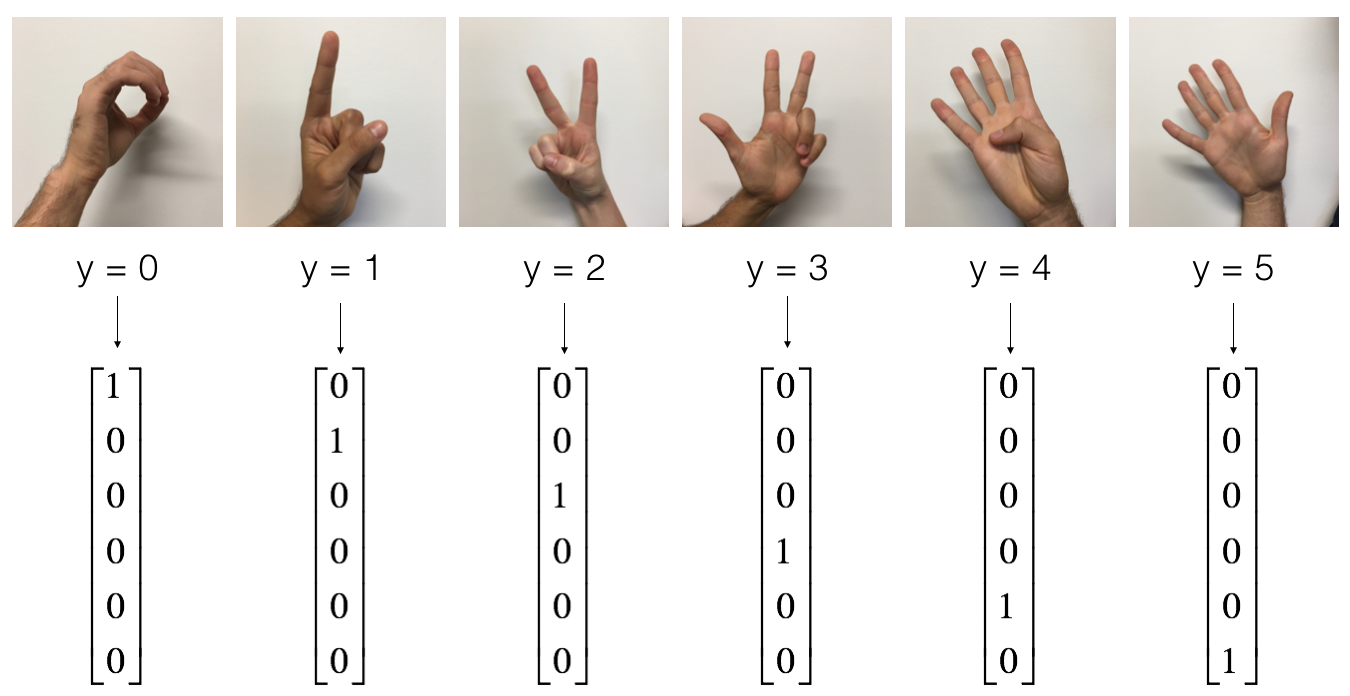
Let's load the SIGNS Dataset.
<img src="images/signs_data_kiank.png" style="width:450px;height:250px;">
<caption><center> <u> <font color='purple'> **Figure 6** </u><font color='purple'>  : **SIGNS dataset** </center></caption>

Let's load the SIGNS Dataset.

Figure 6 : SIGNS dataset
In [61]:
 
X_train_orig, Y_train_orig, X_test_orig, Y_test_orig, classes = load_dataset()
# Normalize image vectors
X_train = X_train_orig/255.
X_test = X_test_orig/255.
# Convert training and test labels to one hot matrices
Y_train = convert_to_one_hot(Y_train_orig, 6).T
Y_test = convert_to_one_hot(Y_test_orig, 6).T
print ("number of training examples = " + str(X_train.shape[0]))
print ("number of test examples = " + str(X_test.shape[0]))
print ("X_train shape: " + str(X_train.shape))
print ("Y_train shape: " + str(Y_train.shape))
print ("X_test shape: " + str(X_test.shape))
print ("Y_test shape: " + str(Y_test.shape))
number of training examples = 1080
number of test examples = 120
X_train shape: (1080, 64, 64, 3)
Y_train shape: (1080, 6)
X_test shape: (120, 64, 64, 3)
Y_test shape: (120, 6)
 
Run the following cell to train your model on 2 epochs with a batch size of 32. On a CPU it should take you around 5min per epoch. 

Run the following cell to train your model on 2 epochs with a batch size of 32. On a CPU it should take you around 5min per epoch.

In [71]:
 
model.fit(X_train, Y_train, epochs = 2, batch_size = 32)
Epoch 1/2
1080/1080 [==============================] - 267s - loss: 0.0791 - acc: 0.9731   
Epoch 2/2
1080/1080 [==============================] - 248s - loss: 0.1192 - acc: 0.9639   
Out[71]:
<keras.callbacks.History at 0x7f77f4068710>
 
**Expected Output**:
<table>
    <tr>
        <td>
            ** Epoch 1/2**
        </td>
        <td>
           loss: between 1 and 5, acc: between 0.2 and 0.5, although your results can be different from ours.
        </td>
    </tr>
    <tr>
        <td>
            ** Epoch 2/2**
        </td>
        <td>
           loss: between 1 and 5, acc: between 0.2 and 0.5, you should see your loss decreasing and the accuracy increasing.
        </td>
    </tr>
</table>

Expected Output:

Epoch 1/2 loss: between 1 and 5, acc: between 0.2 and 0.5, although your results can be different from ours.
Epoch 2/2 loss: between 1 and 5, acc: between 0.2 and 0.5, you should see your loss decreasing and the accuracy increasing.
 
Let's see how this model (trained on only two epochs) performs on the test set.

Let's see how this model (trained on only two epochs) performs on the test set.

In [72]:
 
preds = model.evaluate(X_test, Y_test)
print ("Loss = " + str(preds[0]))
print ("Test Accuracy = " + str(preds[1]))
120/120 [==============================] - 8s     
Loss = 0.586825978756
Test Accuracy = 0.85833332936
 
**Expected Output**:
<table>
    <tr>
        <td>
            **Test Accuracy**
        </td>
        <td>
           between 0.16 and 0.25
        </td>
    </tr>
</table>

Expected Output:

Test Accuracy between 0.16 and 0.25
 
For the purpose of this assignment, we've asked you to train the model only for two epochs. You can see that it achieves poor performances. Please go ahead and submit your assignment; to check correctness, the online grader will run your code only for a small number of epochs as well.

For the purpose of this assignment, we've asked you to train the model only for two epochs. You can see that it achieves poor performances. Please go ahead and submit your assignment; to check correctness, the online grader will run your code only for a small number of epochs as well.

 
After you have finished this official (graded) part of this assignment, you can also optionally train the ResNet for more iterations, if you want. We get a lot better performance when we train for ~20 epochs, but this will take more than an hour when training on a CPU. 
Using a GPU, we've trained our own ResNet50 model's weights on the SIGNS dataset. You can load and run our trained model on the test set in the cells below. It may take ≈1min to load the model.

After you have finished this official (graded) part of this assignment, you can also optionally train the ResNet for more iterations, if you want. We get a lot better performance when we train for ~20 epochs, but this will take more than an hour when training on a CPU.

Using a GPU, we've trained our own ResNet50 model's weights on the SIGNS dataset. You can load and run our trained model on the test set in the cells below. It may take ≈1min to load the model.

In [*]:
 
model = load_model('ResNet50.h5') 
In [*]:
 
preds = model.evaluate(X_test, Y_test)
print ("Loss = " + str(preds[0]))
print ("Test Accuracy = " + str(preds[1]))
 
ResNet50 is a powerful model for image classification when it is trained for an adequate number of iterations. We hope you can use what you've learnt and apply it to your own classification problem to perform state-of-the-art accuracy.
Congratulations on finishing this assignment! You've now implemented a state-of-the-art image classification system! 

ResNet50 is a powerful model for image classification when it is trained for an adequate number of iterations. We hope you can use what you've learnt and apply it to your own classification problem to perform state-of-the-art accuracy.

Congratulations on finishing this assignment! You've now implemented a state-of-the-art image classification system!

 
## 4 - Test on your own image (Optional/Ungraded)

4 - Test on your own image (Optional/Ungraded)

 
If you wish, you can also take a picture of your own hand and see the output of the model. To do this:
    1. Click on "File" in the upper bar of this notebook, then click "Open" to go on your Coursera Hub.
    2. Add your image to this Jupyter Notebook's directory, in the "images" folder
    3. Write your image's name in the following code
    4. Run the code and check if the algorithm is right! 

If you wish, you can also take a picture of your own hand and see the output of the model. To do this:

1. Click on "File" in the upper bar of this notebook, then click "Open" to go on your Coursera Hub.
2. Add your image to this Jupyter Notebook's directory, in the "images" folder
3. Write your image's name in the following code
4. Run the code and check if the algorithm is right! 
In [70]:
 
img_path = 'images/my_image.jpg'
img = image.load_img(img_path, target_size=(64, 64))
x = image.img_to_array(img)
x = np.expand_dims(x, axis=0)
x = preprocess_input(x)
print('Input image shape:', x.shape)
my_image = scipy.misc.imread(img_path)
imshow(my_image)
print("class prediction vector [p(0), p(1), p(2), p(3), p(4), p(5)] = ")
print(model.predict(x))
Input image shape: (1, 64, 64, 3)
class prediction vector [p(0), p(1), p(2), p(3), p(4), p(5)] = 
[[ 1.  0.  0.  0.  0.  0.]]
 
You can also print a summary of your model by running the following code.

You can also print a summary of your model by running the following code.

In [68]:
 
model.summary()
____________________________________________________________________________________________________
Layer (type)                     Output Shape          Param #     Connected to                     
====================================================================================================
input_1 (InputLayer)             (None, 64, 64, 3)     0                                            
____________________________________________________________________________________________________
zero_padding2d_1 (ZeroPadding2D) (None, 70, 70, 3)     0           input_1[0][0]                    
____________________________________________________________________________________________________
conv1 (Conv2D)                   (None, 32, 32, 64)    9472        zero_padding2d_1[0][0]           
____________________________________________________________________________________________________
bn_conv1 (BatchNormalization)    (None, 32, 32, 64)    256         conv1[0][0]                      
____________________________________________________________________________________________________
activation_4 (Activation)        (None, 32, 32, 64)    0           bn_conv1[0][0]                   
____________________________________________________________________________________________________
max_pooling2d_1 (MaxPooling2D)   (None, 15, 15, 64)    0           activation_4[0][0]               
____________________________________________________________________________________________________
res2a_branch2a (Conv2D)          (None, 15, 15, 64)    4160        max_pooling2d_1[0][0]            
____________________________________________________________________________________________________
bn2a_branch2a (BatchNormalizatio (None, 15, 15, 64)    256         res2a_branch2a[0][0]             
____________________________________________________________________________________________________
activation_5 (Activation)        (None, 15, 15, 64)    0           bn2a_branch2a[0][0]              
____________________________________________________________________________________________________
res2a_branch2b (Conv2D)          (None, 15, 15, 64)    36928       activation_5[0][0]               
____________________________________________________________________________________________________
bn2a_branch2b (BatchNormalizatio (None, 15, 15, 64)    256         res2a_branch2b[0][0]             
____________________________________________________________________________________________________
activation_6 (Activation)        (None, 15, 15, 64)    0           bn2a_branch2b[0][0]              
____________________________________________________________________________________________________
res2a_branch2c (Conv2D)          (None, 15, 15, 256)   16640       activation_6[0][0]               
____________________________________________________________________________________________________
res2a_branch1 (Conv2D)           (None, 15, 15, 256)   16640       max_pooling2d_1[0][0]            
____________________________________________________________________________________________________
bn2a_branch2c (BatchNormalizatio (None, 15, 15, 256)   1024        res2a_branch2c[0][0]             
____________________________________________________________________________________________________
bn2a_branch1 (BatchNormalization (None, 15, 15, 256)   1024        res2a_branch1[0][0]              
____________________________________________________________________________________________________
add_2 (Add)                      (None, 15, 15, 256)   0           bn2a_branch2c[0][0]              
                                                                   bn2a_branch1[0][0]               
____________________________________________________________________________________________________
activation_7 (Activation)        (None, 15, 15, 256)   0           add_2[0][0]                      
____________________________________________________________________________________________________
res2b_branch2a (Conv2D)          (None, 15, 15, 64)    16448       activation_7[0][0]               
____________________________________________________________________________________________________
bn2b_branch2a (BatchNormalizatio (None, 15, 15, 64)    256         res2b_branch2a[0][0]             
____________________________________________________________________________________________________
activation_8 (Activation)        (None, 15, 15, 64)    0           bn2b_branch2a[0][0]              
____________________________________________________________________________________________________
res2b_branch2b (Conv2D)          (None, 15, 15, 64)    36928       activation_8[0][0]               
____________________________________________________________________________________________________
bn2b_branch2b (BatchNormalizatio (None, 15, 15, 64)    256         res2b_branch2b[0][0]             
____________________________________________________________________________________________________
activation_9 (Activation)        (None, 15, 15, 64)    0           bn2b_branch2b[0][0]              
____________________________________________________________________________________________________
res2b_branch2c (Conv2D)          (None, 15, 15, 256)   16640       activation_9[0][0]               
____________________________________________________________________________________________________
bn2b_branch2c (BatchNormalizatio (None, 15, 15, 256)   1024        res2b_branch2c[0][0]             
____________________________________________________________________________________________________
add_3 (Add)                      (None, 15, 15, 256)   0           bn2b_branch2c[0][0]              
                                                                   activation_7[0][0]               
____________________________________________________________________________________________________
activation_10 (Activation)       (None, 15, 15, 256)   0           add_3[0][0]                      
____________________________________________________________________________________________________
res2c_branch2a (Conv2D)          (None, 15, 15, 64)    16448       activation_10[0][0]              
____________________________________________________________________________________________________
bn2c_branch2a (BatchNormalizatio (None, 15, 15, 64)    256         res2c_branch2a[0][0]             
____________________________________________________________________________________________________
activation_11 (Activation)       (None, 15, 15, 64)    0           bn2c_branch2a[0][0]              
____________________________________________________________________________________________________
res2c_branch2b (Conv2D)          (None, 15, 15, 64)    36928       activation_11[0][0]              
____________________________________________________________________________________________________
bn2c_branch2b (BatchNormalizatio (None, 15, 15, 64)    256         res2c_branch2b[0][0]             
____________________________________________________________________________________________________
activation_12 (Activation)       (None, 15, 15, 64)    0           bn2c_branch2b[0][0]              
____________________________________________________________________________________________________
res2c_branch2c (Conv2D)          (None, 15, 15, 256)   16640       activation_12[0][0]              
____________________________________________________________________________________________________
bn2c_branch2c (BatchNormalizatio (None, 15, 15, 256)   1024        res2c_branch2c[0][0]             
____________________________________________________________________________________________________
add_4 (Add)                      (None, 15, 15, 256)   0           bn2c_branch2c[0][0]              
                                                                   activation_10[0][0]              
____________________________________________________________________________________________________
activation_13 (Activation)       (None, 15, 15, 256)   0           add_4[0][0]                      
____________________________________________________________________________________________________
res3a_branch2a (Conv2D)          (None, 8, 8, 128)     32896       activation_13[0][0]              
____________________________________________________________________________________________________
bn3a_branch2a (BatchNormalizatio (None, 8, 8, 128)     512         res3a_branch2a[0][0]             
____________________________________________________________________________________________________
activation_14 (Activation)       (None, 8, 8, 128)     0           bn3a_branch2a[0][0]              
____________________________________________________________________________________________________
res3a_branch2b (Conv2D)          (None, 8, 8, 128)     147584      activation_14[0][0]              
____________________________________________________________________________________________________
bn3a_branch2b (BatchNormalizatio (None, 8, 8, 128)     512         res3a_branch2b[0][0]             
____________________________________________________________________________________________________
activation_15 (Activation)       (None, 8, 8, 128)     0           bn3a_branch2b[0][0]              
____________________________________________________________________________________________________
res3a_branch2c (Conv2D)          (None, 8, 8, 512)     66048       activation_15[0][0]              
____________________________________________________________________________________________________
res3a_branch1 (Conv2D)           (None, 8, 8, 512)     131584      activation_13[0][0]              
____________________________________________________________________________________________________
bn3a_branch2c (BatchNormalizatio (None, 8, 8, 512)     2048        res3a_branch2c[0][0]             
____________________________________________________________________________________________________
bn3a_branch1 (BatchNormalization (None, 8, 8, 512)     2048        res3a_branch1[0][0]              
____________________________________________________________________________________________________
add_5 (Add)                      (None, 8, 8, 512)     0           bn3a_branch2c[0][0]              
                                                                   bn3a_branch1[0][0]               
____________________________________________________________________________________________________
activation_16 (Activation)       (None, 8, 8, 512)     0           add_5[0][0]                      
____________________________________________________________________________________________________
res3b_branch2a (Conv2D)          (None, 8, 8, 128)     65664       activation_16[0][0]              
____________________________________________________________________________________________________
bn3b_branch2a (BatchNormalizatio (None, 8, 8, 128)     512         res3b_branch2a[0][0]             
____________________________________________________________________________________________________
activation_17 (Activation)       (None, 8, 8, 128)     0           bn3b_branch2a[0][0]              
____________________________________________________________________________________________________
res3b_branch2b (Conv2D)          (None, 8, 8, 128)     147584      activation_17[0][0]              
____________________________________________________________________________________________________
bn3b_branch2b (BatchNormalizatio (None, 8, 8, 128)     512         res3b_branch2b[0][0]             
____________________________________________________________________________________________________
activation_18 (Activation)       (None, 8, 8, 128)     0           bn3b_branch2b[0][0]              
____________________________________________________________________________________________________
res3b_branch2c (Conv2D)          (None, 8, 8, 512)     66048       activation_18[0][0]              
____________________________________________________________________________________________________
bn3b_branch2c (BatchNormalizatio (None, 8, 8, 512)     2048        res3b_branch2c[0][0]             
____________________________________________________________________________________________________
add_6 (Add)                      (None, 8, 8, 512)     0           bn3b_branch2c[0][0]              
                                                                   activation_16[0][0]              
____________________________________________________________________________________________________
activation_19 (Activation)       (None, 8, 8, 512)     0           add_6[0][0]                      
____________________________________________________________________________________________________
res3c_branch2a (Conv2D)          (None, 8, 8, 128)     65664       activation_19[0][0]              
____________________________________________________________________________________________________
bn3c_branch2a (BatchNormalizatio (None, 8, 8, 128)     512         res3c_branch2a[0][0]             
____________________________________________________________________________________________________
activation_20 (Activation)       (None, 8, 8, 128)     0           bn3c_branch2a[0][0]              
____________________________________________________________________________________________________
res3c_branch2b (Conv2D)          (None, 8, 8, 128)     147584      activation_20[0][0]              
____________________________________________________________________________________________________
bn3c_branch2b (BatchNormalizatio (None, 8, 8, 128)     512         res3c_branch2b[0][0]             
____________________________________________________________________________________________________
activation_21 (Activation)       (None, 8, 8, 128)     0           bn3c_branch2b[0][0]              
____________________________________________________________________________________________________
res3c_branch2c (Conv2D)          (None, 8, 8, 512)     66048       activation_21[0][0]              
____________________________________________________________________________________________________
bn3c_branch2c (BatchNormalizatio (None, 8, 8, 512)     2048        res3c_branch2c[0][0]             
____________________________________________________________________________________________________
add_7 (Add)                      (None, 8, 8, 512)     0           bn3c_branch2c[0][0]              
                                                                   activation_19[0][0]              
____________________________________________________________________________________________________
activation_22 (Activation)       (None, 8, 8, 512)     0           add_7[0][0]                      
____________________________________________________________________________________________________
res3d_branch2a (Conv2D)          (None, 8, 8, 128)     65664       activation_22[0][0]              
____________________________________________________________________________________________________
bn3d_branch2a (BatchNormalizatio (None, 8, 8, 128)     512         res3d_branch2a[0][0]             
____________________________________________________________________________________________________
activation_23 (Activation)       (None, 8, 8, 128)     0           bn3d_branch2a[0][0]              
____________________________________________________________________________________________________
res3d_branch2b (Conv2D)          (None, 8, 8, 128)     147584      activation_23[0][0]              
____________________________________________________________________________________________________
bn3d_branch2b (BatchNormalizatio (None, 8, 8, 128)     512         res3d_branch2b[0][0]             
____________________________________________________________________________________________________
activation_24 (Activation)       (None, 8, 8, 128)     0           bn3d_branch2b[0][0]              
____________________________________________________________________________________________________
res3d_branch2c (Conv2D)          (None, 8, 8, 512)     66048       activation_24[0][0]              
____________________________________________________________________________________________________
bn3d_branch2c (BatchNormalizatio (None, 8, 8, 512)     2048        res3d_branch2c[0][0]             
____________________________________________________________________________________________________
add_8 (Add)                      (None, 8, 8, 512)     0           bn3d_branch2c[0][0]              
                                                                   activation_22[0][0]              
____________________________________________________________________________________________________
activation_25 (Activation)       (None, 8, 8, 512)     0           add_8[0][0]                      
____________________________________________________________________________________________________
res4a_branch2a (Conv2D)          (None, 4, 4, 256)     131328      activation_25[0][0]              
____________________________________________________________________________________________________
bn4a_branch2a (BatchNormalizatio (None, 4, 4, 256)     1024        res4a_branch2a[0][0]             
____________________________________________________________________________________________________
activation_26 (Activation)       (None, 4, 4, 256)     0           bn4a_branch2a[0][0]              
____________________________________________________________________________________________________
res4a_branch2b (Conv2D)          (None, 4, 4, 256)     590080      activation_26[0][0]              
____________________________________________________________________________________________________
bn4a_branch2b (BatchNormalizatio (None, 4, 4, 256)     1024        res4a_branch2b[0][0]             
____________________________________________________________________________________________________
activation_27 (Activation)       (None, 4, 4, 256)     0           bn4a_branch2b[0][0]              
____________________________________________________________________________________________________
res4a_branch2c (Conv2D)          (None, 4, 4, 1024)    263168      activation_27[0][0]              
____________________________________________________________________________________________________
res4a_branch1 (Conv2D)           (None, 4, 4, 1024)    525312      activation_25[0][0]              
____________________________________________________________________________________________________
bn4a_branch2c (BatchNormalizatio (None, 4, 4, 1024)    4096        res4a_branch2c[0][0]             
____________________________________________________________________________________________________
bn4a_branch1 (BatchNormalization (None, 4, 4, 1024)    4096        res4a_branch1[0][0]              
____________________________________________________________________________________________________
add_9 (Add)                      (None, 4, 4, 1024)    0           bn4a_branch2c[0][0]              
                                                                   bn4a_branch1[0][0]               
____________________________________________________________________________________________________
activation_28 (Activation)       (None, 4, 4, 1024)    0           add_9[0][0]                      
____________________________________________________________________________________________________
res4b_branch2a (Conv2D)          (None, 4, 4, 256)     262400      activation_28[0][0]              
____________________________________________________________________________________________________
bn4b_branch2a (BatchNormalizatio (None, 4, 4, 256)     1024        res4b_branch2a[0][0]             
____________________________________________________________________________________________________
activation_29 (Activation)       (None, 4, 4, 256)     0           bn4b_branch2a[0][0]              
____________________________________________________________________________________________________
res4b_branch2b (Conv2D)          (None, 4, 4, 256)     590080      activation_29[0][0]              
____________________________________________________________________________________________________
bn4b_branch2b (BatchNormalizatio (None, 4, 4, 256)     1024        res4b_branch2b[0][0]             
____________________________________________________________________________________________________
activation_30 (Activation)       (None, 4, 4, 256)     0           bn4b_branch2b[0][0]              
____________________________________________________________________________________________________
res4b_branch2c (Conv2D)          (None, 4, 4, 1024)    263168      activation_30[0][0]              
____________________________________________________________________________________________________
bn4b_branch2c (BatchNormalizatio (None, 4, 4, 1024)    4096        res4b_branch2c[0][0]             
____________________________________________________________________________________________________
add_10 (Add)                     (None, 4, 4, 1024)    0           bn4b_branch2c[0][0]              
                                                                   activation_28[0][0]              
____________________________________________________________________________________________________
activation_31 (Activation)       (None, 4, 4, 1024)    0           add_10[0][0]                     
____________________________________________________________________________________________________
res4c_branch2a (Conv2D)          (None, 4, 4, 256)     262400      activation_31[0][0]              
____________________________________________________________________________________________________
bn4c_branch2a (BatchNormalizatio (None, 4, 4, 256)     1024        res4c_branch2a[0][0]             
____________________________________________________________________________________________________
activation_32 (Activation)       (None, 4, 4, 256)     0           bn4c_branch2a[0][0]              
____________________________________________________________________________________________________
res4c_branch2b (Conv2D)          (None, 4, 4, 256)     590080      activation_32[0][0]              
____________________________________________________________________________________________________
bn4c_branch2b (BatchNormalizatio (None, 4, 4, 256)     1024        res4c_branch2b[0][0]             
____________________________________________________________________________________________________
activation_33 (Activation)       (None, 4, 4, 256)     0           bn4c_branch2b[0][0]              
____________________________________________________________________________________________________
res4c_branch2c (Conv2D)          (None, 4, 4, 1024)    263168      activation_33[0][0]              
____________________________________________________________________________________________________
bn4c_branch2c (BatchNormalizatio (None, 4, 4, 1024)    4096        res4c_branch2c[0][0]             
____________________________________________________________________________________________________
add_11 (Add)                     (None, 4, 4, 1024)    0           bn4c_branch2c[0][0]              
                                                                   activation_31[0][0]              
____________________________________________________________________________________________________
activation_34 (Activation)       (None, 4, 4, 1024)    0           add_11[0][0]                     
____________________________________________________________________________________________________
res4d_branch2a (Conv2D)          (None, 4, 4, 256)     262400      activation_34[0][0]              
____________________________________________________________________________________________________
bn4d_branch2a (BatchNormalizatio (None, 4, 4, 256)     1024        res4d_branch2a[0][0]             
____________________________________________________________________________________________________
activation_35 (Activation)       (None, 4, 4, 256)     0           bn4d_branch2a[0][0]              
____________________________________________________________________________________________________
res4d_branch2b (Conv2D)          (None, 4, 4, 256)     590080      activation_35[0][0]              
____________________________________________________________________________________________________
bn4d_branch2b (BatchNormalizatio (None, 4, 4, 256)     1024        res4d_branch2b[0][0]             
____________________________________________________________________________________________________
activation_36 (Activation)       (None, 4, 4, 256)     0           bn4d_branch2b[0][0]              
____________________________________________________________________________________________________
res4d_branch2c (Conv2D)          (None, 4, 4, 1024)    263168      activation_36[0][0]              
____________________________________________________________________________________________________
bn4d_branch2c (BatchNormalizatio (None, 4, 4, 1024)    4096        res4d_branch2c[0][0]             
____________________________________________________________________________________________________
add_12 (Add)                     (None, 4, 4, 1024)    0           bn4d_branch2c[0][0]              
                                                                   activation_34[0][0]              
____________________________________________________________________________________________________
activation_37 (Activation)       (None, 4, 4, 1024)    0           add_12[0][0]                     
____________________________________________________________________________________________________
res4e_branch2a (Conv2D)          (None, 4, 4, 256)     262400      activation_37[0][0]              
____________________________________________________________________________________________________
bn4e_branch2a (BatchNormalizatio (None, 4, 4, 256)     1024        res4e_branch2a[0][0]             
____________________________________________________________________________________________________
activation_38 (Activation)       (None, 4, 4, 256)     0           bn4e_branch2a[0][0]              
____________________________________________________________________________________________________
res4e_branch2b (Conv2D)          (None, 4, 4, 256)     590080      activation_38[0][0]              
____________________________________________________________________________________________________
bn4e_branch2b (BatchNormalizatio (None, 4, 4, 256)     1024        res4e_branch2b[0][0]             
____________________________________________________________________________________________________
activation_39 (Activation)       (None, 4, 4, 256)     0           bn4e_branch2b[0][0]              
____________________________________________________________________________________________________
res4e_branch2c (Conv2D)          (None, 4, 4, 1024)    263168      activation_39[0][0]              
____________________________________________________________________________________________________
bn4e_branch2c (BatchNormalizatio (None, 4, 4, 1024)    4096        res4e_branch2c[0][0]             
____________________________________________________________________________________________________
add_13 (Add)                     (None, 4, 4, 1024)    0           bn4e_branch2c[0][0]              
                                                                   activation_37[0][0]              
____________________________________________________________________________________________________
activation_40 (Activation)       (None, 4, 4, 1024)    0           add_13[0][0]                     
____________________________________________________________________________________________________
res4f_branch2a (Conv2D)          (None, 4, 4, 256)     262400      activation_40[0][0]              
____________________________________________________________________________________________________
bn4f_branch2a (BatchNormalizatio (None, 4, 4, 256)     1024        res4f_branch2a[0][0]             
____________________________________________________________________________________________________
activation_41 (Activation)       (None, 4, 4, 256)     0           bn4f_branch2a[0][0]              
____________________________________________________________________________________________________
res4f_branch2b (Conv2D)          (None, 4, 4, 256)     590080      activation_41[0][0]              
____________________________________________________________________________________________________
bn4f_branch2b (BatchNormalizatio (None, 4, 4, 256)     1024        res4f_branch2b[0][0]             
____________________________________________________________________________________________________
activation_42 (Activation)       (None, 4, 4, 256)     0           bn4f_branch2b[0][0]              
____________________________________________________________________________________________________
res4f_branch2c (Conv2D)          (None, 4, 4, 1024)    263168      activation_42[0][0]              
____________________________________________________________________________________________________
bn4f_branch2c (BatchNormalizatio (None, 4, 4, 1024)    4096        res4f_branch2c[0][0]             
____________________________________________________________________________________________________
add_14 (Add)                     (None, 4, 4, 1024)    0           bn4f_branch2c[0][0]              
                                                                   activation_40[0][0]              
____________________________________________________________________________________________________
activation_43 (Activation)       (None, 4, 4, 1024)    0           add_14[0][0]                     
____________________________________________________________________________________________________
res5a_branch2a (Conv2D)          (None, 2, 2, 512)     524800      activation_43[0][0]              
____________________________________________________________________________________________________
bn5a_branch2a (BatchNormalizatio (None, 2, 2, 512)     2048        res5a_branch2a[0][0]             
____________________________________________________________________________________________________
activation_44 (Activation)       (None, 2, 2, 512)     0           bn5a_branch2a[0][0]              
____________________________________________________________________________________________________
res5a_branch2b (Conv2D)          (None, 2, 2, 512)     2359808     activation_44[0][0]              
____________________________________________________________________________________________________
bn5a_branch2b (BatchNormalizatio (None, 2, 2, 512)     2048        res5a_branch2b[0][0]             
____________________________________________________________________________________________________
activation_45 (Activation)       (None, 2, 2, 512)     0           bn5a_branch2b[0][0]              
____________________________________________________________________________________________________
res5a_branch2c (Conv2D)          (None, 2, 2, 2048)    1050624     activation_45[0][0]              
____________________________________________________________________________________________________
res5a_branch1 (Conv2D)           (None, 2, 2, 2048)    2099200     activation_43[0][0]              
____________________________________________________________________________________________________
bn5a_branch2c (BatchNormalizatio (None, 2, 2, 2048)    8192        res5a_branch2c[0][0]             
____________________________________________________________________________________________________
bn5a_branch1 (BatchNormalization (None, 2, 2, 2048)    8192        res5a_branch1[0][0]              
____________________________________________________________________________________________________
add_15 (Add)                     (None, 2, 2, 2048)    0           bn5a_branch2c[0][0]              
                                                                   bn5a_branch1[0][0]               
____________________________________________________________________________________________________
activation_46 (Activation)       (None, 2, 2, 2048)    0           add_15[0][0]                     
____________________________________________________________________________________________________
res5b_branch2a (Conv2D)          (None, 2, 2, 512)     1049088     activation_46[0][0]              
____________________________________________________________________________________________________
bn5b_branch2a (BatchNormalizatio (None, 2, 2, 512)     2048        res5b_branch2a[0][0]             
____________________________________________________________________________________________________
activation_47 (Activation)       (None, 2, 2, 512)     0           bn5b_branch2a[0][0]              
____________________________________________________________________________________________________
res5b_branch2b (Conv2D)          (None, 2, 2, 512)     2359808     activation_47[0][0]              
____________________________________________________________________________________________________
bn5b_branch2b (BatchNormalizatio (None, 2, 2, 512)     2048        res5b_branch2b[0][0]             
____________________________________________________________________________________________________
activation_48 (Activation)       (None, 2, 2, 512)     0           bn5b_branch2b[0][0]              
____________________________________________________________________________________________________
res5b_branch2c (Conv2D)          (None, 2, 2, 2048)    1050624     activation_48[0][0]              
____________________________________________________________________________________________________
bn5b_branch2c (BatchNormalizatio (None, 2, 2, 2048)    8192        res5b_branch2c[0][0]             
____________________________________________________________________________________________________
add_16 (Add)                     (None, 2, 2, 2048)    0           bn5b_branch2c[0][0]              
                                                                   activation_46[0][0]              
____________________________________________________________________________________________________
activation_49 (Activation)       (None, 2, 2, 2048)    0           add_16[0][0]                     
____________________________________________________________________________________________________
res5c_branch2a (Conv2D)          (None, 2, 2, 512)     1049088     activation_49[0][0]              
____________________________________________________________________________________________________
bn5c_branch2a (BatchNormalizatio (None, 2, 2, 512)     2048        res5c_branch2a[0][0]             
____________________________________________________________________________________________________
activation_50 (Activation)       (None, 2, 2, 512)     0           bn5c_branch2a[0][0]              
____________________________________________________________________________________________________
res5c_branch2b (Conv2D)          (None, 2, 2, 512)     2359808     activation_50[0][0]              
____________________________________________________________________________________________________
bn5c_branch2b (BatchNormalizatio (None, 2, 2, 512)     2048        res5c_branch2b[0][0]             
____________________________________________________________________________________________________
activation_51 (Activation)       (None, 2, 2, 512)     0           bn5c_branch2b[0][0]              
____________________________________________________________________________________________________
res5c_branch2c (Conv2D)          (None, 2, 2, 2048)    1050624     activation_51[0][0]              
____________________________________________________________________________________________________
bn5c_branch2c (BatchNormalizatio (None, 2, 2, 2048)    8192        res5c_branch2c[0][0]             
____________________________________________________________________________________________________
add_17 (Add)                     (None, 2, 2, 2048)    0           bn5c_branch2c[0][0]              
                                                                   activation_49[0][0]              
____________________________________________________________________________________________________
activation_52 (Activation)       (None, 2, 2, 2048)    0           add_17[0][0]                     
____________________________________________________________________________________________________
avg_pool (AveragePooling2D)      (None, 1, 1, 2048)    0           activation_52[0][0]              
____________________________________________________________________________________________________
flatten_1 (Flatten)              (None, 2048)          0           avg_pool[0][0]                   
____________________________________________________________________________________________________
fc6 (Dense)                      (None, 6)             12294       flatten_1[0][0]                  
====================================================================================================
Total params: 23,600,006
Trainable params: 23,546,886
Non-trainable params: 53,120
____________________________________________________________________________________________________
 
Finally, run the code below to visualize your ResNet50. You can also download a .png picture of your model by going to "File -> Open...-> model.png".

Finally, run the code below to visualize your ResNet50. You can also download a .png picture of your model by going to "File -> Open...-> model.png".

In [69]:
 
plot_model(model, to_file='model.png')
SVG(model_to_dot(model).create(prog='dot', format='svg'))
Out[69]:
G 140155532618048 input_1: InputLayer 140155459985480 zero_padding2d_1: ZeroPadding2D 140155532618048->140155459985480 140155459985536 conv1: Conv2D 140155459985480->140155459985536 140155459986096 bn_conv1: BatchNormalization 140155459985536->140155459986096 140155459986712 activation_4: Activation 140155459986096->140155459986712 140155459986768 max_pooling2d_1: MaxPooling2D 140155459986712->140155459986768 140155459986936 res2a_branch2a: Conv2D 140155459986768->140155459986936 140155459988728 res2a_branch1: Conv2D 140155459986768->140155459988728 140155459987272 bn2a_branch2a: BatchNormalization 140155459986936->140155459987272 140155459987608 activation_5: Activation 140155459987272->140155459987608 140155459987664 res2a_branch2b: Conv2D 140155459987608->140155459987664 140155459988000 bn2a_branch2b: BatchNormalization 140155459987664->140155459988000 140155459988336 activation_6: Activation 140155459988000->140155459988336 140155459988392 res2a_branch2c: Conv2D 140155459988336->140155459988392 140155459989120 bn2a_branch2c: BatchNormalization 140155459988392->140155459989120 140155498478000 bn2a_branch1: BatchNormalization 140155459988728->140155498478000 140155460026664 add_2: Add 140155459989120->140155460026664 140155498478000->140155460026664 140155460026720 activation_7: Activation 140155460026664->140155460026720 140155460026776 res2b_branch2a: Conv2D 140155460026720->140155460026776 140155460028904 add_3: Add 140155460026720->140155460028904 140155460027112 bn2b_branch2a: BatchNormalization 140155460026776->140155460027112 140155460027448 activation_8: Activation 140155460027112->140155460027448 140155460027504 res2b_branch2b: Conv2D 140155460027448->140155460027504 140155460027840 bn2b_branch2b: BatchNormalization 140155460027504->140155460027840 140155460028176 activation_9: Activation 140155460027840->140155460028176 140155460028232 res2b_branch2c: Conv2D 140155460028176->140155460028232 140155460028568 bn2b_branch2c: BatchNormalization 140155460028232->140155460028568 140155460028568->140155460028904 140155460028960 activation_10: Activation 140155460028904->140155460028960 140155460029016 res2c_branch2a: Conv2D 140155460028960->140155460029016 140155460039400 add_4: Add 140155460028960->140155460039400 140155460029352 bn2c_branch2a: BatchNormalization 140155460029016->140155460029352 140155460029688 activation_11: Activation 140155460029352->140155460029688 140155460029744 res2c_branch2b: Conv2D 140155460029688->140155460029744 140155460030080 bn2c_branch2b: BatchNormalization 140155460029744->140155460030080 140155459989456 activation_12: Activation 140155460030080->140155459989456 140155460038728 res2c_branch2c: Conv2D 140155459989456->140155460038728 140155460039064 bn2c_branch2c: BatchNormalization 140155460038728->140155460039064 140155460039064->140155460039400 140155460039456 activation_13: Activation 140155460039400->140155460039456 140155460039512 res3a_branch2a: Conv2D 140155460039456->140155460039512 140155460041304 res3a_branch1: Conv2D 140155460039456->140155460041304 140155460039848 bn3a_branch2a: BatchNormalization 140155460039512->140155460039848 140155460040184 activation_14: Activation 140155460039848->140155460040184 140155460040240 res3a_branch2b: Conv2D 140155460040184->140155460040240 140155460040576 bn3a_branch2b: BatchNormalization 140155460040240->140155460040576 140155460040912 activation_15: Activation 140155460040576->140155460040912 140155460040968 res3a_branch2c: Conv2D 140155460040912->140155460040968 140155460041696 bn3a_branch2c: BatchNormalization 140155460040968->140155460041696 140155460042032 bn3a_branch1: BatchNormalization 140155460041304->140155460042032 140155460042312 add_5: Add 140155460041696->140155460042312 140155460042032->140155460042312 140155460042368 activation_16: Activation 140155460042312->140155460042368 140155460042424 res3b_branch2a: Conv2D 140155460042368->140155460042424 140155460085576 add_6: Add 140155460042368->140155460085576 140155460030416 bn3b_branch2a: BatchNormalization 140155460042424->140155460030416 140155460084120 activation_17: Activation 140155460030416->140155460084120 140155460084176 res3b_branch2b: Conv2D 140155460084120->140155460084176 140155460084512 bn3b_branch2b: BatchNormalization 140155460084176->140155460084512 140155460084848 activation_18: Activation 140155460084512->140155460084848 140155460084904 res3b_branch2c: Conv2D 140155460084848->140155460084904 140155460085240 bn3b_branch2c: BatchNormalization 140155460084904->140155460085240 140155460085240->140155460085576 140155460085632 activation_19: Activation 140155460085576->140155460085632 140155460085688 res3c_branch2a: Conv2D 140155460085632->140155460085688 140155460042592 add_7: Add 140155460085632->140155460042592 140155460086024 bn3c_branch2a: BatchNormalization 140155460085688->140155460086024 140155460086360 activation_20: Activation 140155460086024->140155460086360 140155460086416 res3c_branch2b: Conv2D 140155460086360->140155460086416 140155460086752 bn3c_branch2b: BatchNormalization 140155460086416->140155460086752 140155460087088 activation_21: Activation 140155460086752->140155460087088 140155460087144 res3c_branch2c: Conv2D 140155460087088->140155460087144 140155460087480 bn3c_branch2c: BatchNormalization 140155460087144->140155460087480 140155460087480->140155460042592 140155460112512 activation_22: Activation 140155460042592->140155460112512 140155460112568 res3d_branch2a: Conv2D 140155460112512->140155460112568 140155460114696 add_8: Add 140155460112512->140155460114696 140155460112904 bn3d_branch2a: BatchNormalization 140155460112568->140155460112904 140155460113240 activation_23: Activation 140155460112904->140155460113240 140155460113296 res3d_branch2b: Conv2D 140155460113240->140155460113296 140155460113632 bn3d_branch2b: BatchNormalization 140155460113296->140155460113632 140155460113968 activation_24: Activation 140155460113632->140155460113968 140155460114024 res3d_branch2c: Conv2D 140155460113968->140155460114024 140155460114360 bn3d_branch2c: BatchNormalization 140155460114024->140155460114360 140155460114360->140155460114696 140155460114752 activation_25: Activation 140155460114696->140155460114752 140155460114808 res4a_branch2a: Conv2D 140155460114752->140155460114808 140155460087760 res4a_branch1: Conv2D 140155460114752->140155460087760 140155460115144 bn4a_branch2a: BatchNormalization 140155460114808->140155460115144 140155460115480 activation_26: Activation 140155460115144->140155460115480 140155460115536 res4a_branch2b: Conv2D 140155460115480->140155460115536 140155460115872 bn4a_branch2b: BatchNormalization 140155460115536->140155460115872 140155460116208 activation_27: Activation 140155460115872->140155460116208 140155460116264 res4a_branch2c: Conv2D 140155460116208->140155460116264 140155460149824 bn4a_branch2c: BatchNormalization 140155460116264->140155460149824 140155460150160 bn4a_branch1: BatchNormalization 140155460087760->140155460150160 140155460150440 add_9: Add 140155460149824->140155460150440 140155460150160->140155460150440 140155460150496 activation_28: Activation 140155460150440->140155460150496 140155460150552 res4b_branch2a: Conv2D 140155460150496->140155460150552 140155460152680 add_10: Add 140155460150496->140155460152680 140155460150888 bn4b_branch2a: BatchNormalization 140155460150552->140155460150888 140155460151224 activation_29: Activation 140155460150888->140155460151224 140155460151280 res4b_branch2b: Conv2D 140155460151224->140155460151280 140155460151616 bn4b_branch2b: BatchNormalization 140155460151280->140155460151616 140155460151952 activation_30: Activation 140155460151616->140155460151952 140155460152008 res4b_branch2c: Conv2D 140155460151952->140155460152008 140155460152344 bn4b_branch2c: BatchNormalization 140155460152008->140155460152344 140155460152344->140155460152680 140155460152736 activation_31: Activation 140155460152680->140155460152736 140155460152792 res4c_branch2a: Conv2D 140155460152736->140155460152792 140155460175464 add_11: Add 140155460152736->140155460175464 140155460153128 bn4c_branch2a: BatchNormalization 140155460152792->140155460153128 140155460116432 activation_32: Activation 140155460153128->140155460116432 140155460174064 res4c_branch2b: Conv2D 140155460116432->140155460174064 140155460174400 bn4c_branch2b: BatchNormalization 140155460174064->140155460174400 140155460174736 activation_33: Activation 140155460174400->140155460174736 140155460174792 res4c_branch2c: Conv2D 140155460174736->140155460174792 140155460175128 bn4c_branch2c: BatchNormalization 140155460174792->140155460175128 140155460175128->140155460175464 140155460175520 activation_34: Activation 140155460175464->140155460175520 140155460175576 res4d_branch2a: Conv2D 140155460175520->140155460175576 140155460177704 add_12: Add 140155460175520->140155460177704 140155460175912 bn4d_branch2a: BatchNormalization 140155460175576->140155460175912 140155460176248 activation_35: Activation 140155460175912->140155460176248 140155460176304 res4d_branch2b: Conv2D 140155460176248->140155460176304 140155460176640 bn4d_branch2b: BatchNormalization 140155460176304->140155460176640 140155460176976 activation_36: Activation 140155460176640->140155460176976 140155460177032 res4d_branch2c: Conv2D 140155460176976->140155460177032 140155460177368 bn4d_branch2c: BatchNormalization 140155460177032->140155460177368 140155460177368->140155460177704 140155460177760 activation_37: Activation 140155460177704->140155460177760 140155460177816 res4e_branch2a: Conv2D 140155460177760->140155460177816 140155459684392 add_13: Add 140155460177760->140155459684392 140155459682600 bn4e_branch2a: BatchNormalization 140155460177816->140155459682600 140155459682936 activation_38: Activation 140155459682600->140155459682936 140155459682992 res4e_branch2b: Conv2D 140155459682936->140155459682992 140155459683328 bn4e_branch2b: BatchNormalization 140155459682992->140155459683328 140155459683664 activation_39: Activation 140155459683328->140155459683664 140155459683720 res4e_branch2c: Conv2D 140155459683664->140155459683720 140155459684056 bn4e_branch2c: BatchNormalization 140155459683720->140155459684056 140155459684056->140155459684392 140155459684448 activation_40: Activation 140155459684392->140155459684448 140155459684504 res4f_branch2a: Conv2D 140155459684448->140155459684504 140155459711272 add_14: Add 140155459684448->140155459711272 140155459684840 bn4f_branch2a: BatchNormalization 140155459684504->140155459684840 140155459685176 activation_41: Activation 140155459684840->140155459685176 140155459685232 res4f_branch2b: Conv2D 140155459685176->140155459685232 140155459685568 bn4f_branch2b: BatchNormalization 140155459685232->140155459685568 140155459685904 activation_42: Activation 140155459685568->140155459685904 140155459685960 res4f_branch2c: Conv2D 140155459685904->140155459685960 140155460153296 bn4f_branch2c: BatchNormalization 140155459685960->140155460153296 140155460153296->140155459711272 140155459711328 activation_43: Activation 140155459711272->140155459711328 140155459711384 res5a_branch2a: Conv2D 140155459711328->140155459711384 140155459713176 res5a_branch1: Conv2D 140155459711328->140155459713176 140155459711720 bn5a_branch2a: BatchNormalization 140155459711384->140155459711720 140155459712056 activation_44: Activation 140155459711720->140155459712056 140155459712112 res5a_branch2b: Conv2D 140155459712056->140155459712112 140155459712448 bn5a_branch2b: BatchNormalization 140155459712112->140155459712448 140155459712784 activation_45: Activation 140155459712448->140155459712784 140155459712840 res5a_branch2c: Conv2D 140155459712784->140155459712840 140155459713568 bn5a_branch2c: BatchNormalization 140155459712840->140155459713568 140155459713904 bn5a_branch1: BatchNormalization 140155459713176->140155459713904 140155459714184 add_15: Add 140155459713568->140155459714184 140155459713904->140155459714184 140155459714240 activation_46: Activation 140155459714184->140155459714240 140155459714296 res5b_branch2a: Conv2D 140155459714240->140155459714296 140155459741064 add_16: Add 140155459714240->140155459741064 140155459714632 bn5b_branch2a: BatchNormalization 140155459714296->140155459714632 140155459714968 activation_47: Activation 140155459714632->140155459714968 140155459686296 res5b_branch2b: Conv2D 140155459714968->140155459686296 140155459740000 bn5b_branch2b: BatchNormalization 140155459686296->140155459740000 140155459740336 activation_48: Activation 140155459740000->140155459740336 140155459740392 res5b_branch2c: Conv2D 140155459740336->140155459740392 140155459740728 bn5b_branch2c: BatchNormalization 140155459740392->140155459740728 140155459740728->140155459741064 140155459741120 activation_49: Activation 140155459741064->140155459741120 140155459741176 res5c_branch2a: Conv2D 140155459741120->140155459741176 140155459743304 add_17: Add 140155459741120->140155459743304 140155459741512 bn5c_branch2a: BatchNormalization 140155459741176->140155459741512 140155459741848 activation_50: Activation 140155459741512->140155459741848 140155459741904 res5c_branch2b: Conv2D 140155459741848->140155459741904 140155459742240 bn5c_branch2b: BatchNormalization 140155459741904->140155459742240 140155459742576 activation_51: Activation 140155459742240->140155459742576 140155459742632 res5c_branch2c: Conv2D 140155459742576->140155459742632 140155459742968 bn5c_branch2c: BatchNormalization 140155459742632->140155459742968 140155459742968->140155459743304 140155459743360 activation_52: Activation 140155459743304->140155459743360 140155459743416 avg_pool: AveragePooling2D 140155459743360->140155459743416 140155459743584 flatten_1: Flatten 140155459743416->140155459743584 140155459715024 fc6: Dense 140155459743584->140155459715024
 
<font color='blue'>
**What you should remember:**
- Very deep "plain" networks don't work in practice because they are hard to train due to vanishing gradients.  
- The skip-connections help to address the Vanishing Gradient problem. They also make it easy for a ResNet block to learn an identity function. 
- There are two main type of blocks: The identity block and the convolutional block. 
- Very deep Residual Networks are built by stacking these blocks together.

What you should remember:

  • Very deep "plain" networks don't work in practice because they are hard to train due to vanishing gradients.
  • The skip-connections help to address the Vanishing Gradient problem. They also make it easy for a ResNet block to learn an identity function.
  • There are two main type of blocks: The identity block and the convolutional block.
  • Very deep Residual Networks are built by stacking these blocks together.

 
### References 
This notebook presents the ResNet algorithm due to He et al. (2015). The implementation here also took significant inspiration and follows the structure given in the github repository of Francois Chollet: 
- Kaiming He, Xiangyu Zhang, Shaoqing Ren, Jian Sun - [Deep Residual Learning for Image Recognition (2015)](https://arxiv.org/abs/1512.03385)
- Francois Chollet's github repository: https://github.com/fchollet/deep-learning-models/blob/master/resnet50.py

References

This notebook presents the ResNet algorithm due to He et al. (2015). The implementation here also took significant inspiration and follows the structure given in the github repository of Francois Chollet:

Rendering widgets...